
Home / Field Notes / Skills
How to Pick a Campsite (And Set It Up in the Right Order)
Ten minutes of looking before you unpack saves the whole weekend.
September 1, 2026 · 8 min read · Clarion Camping
Most people arrive at a campsite, park, and start unloading at whatever spot the car is pointing at. Ten minutes of looking first is one of the highest-return habits in camping — and it costs nothing.
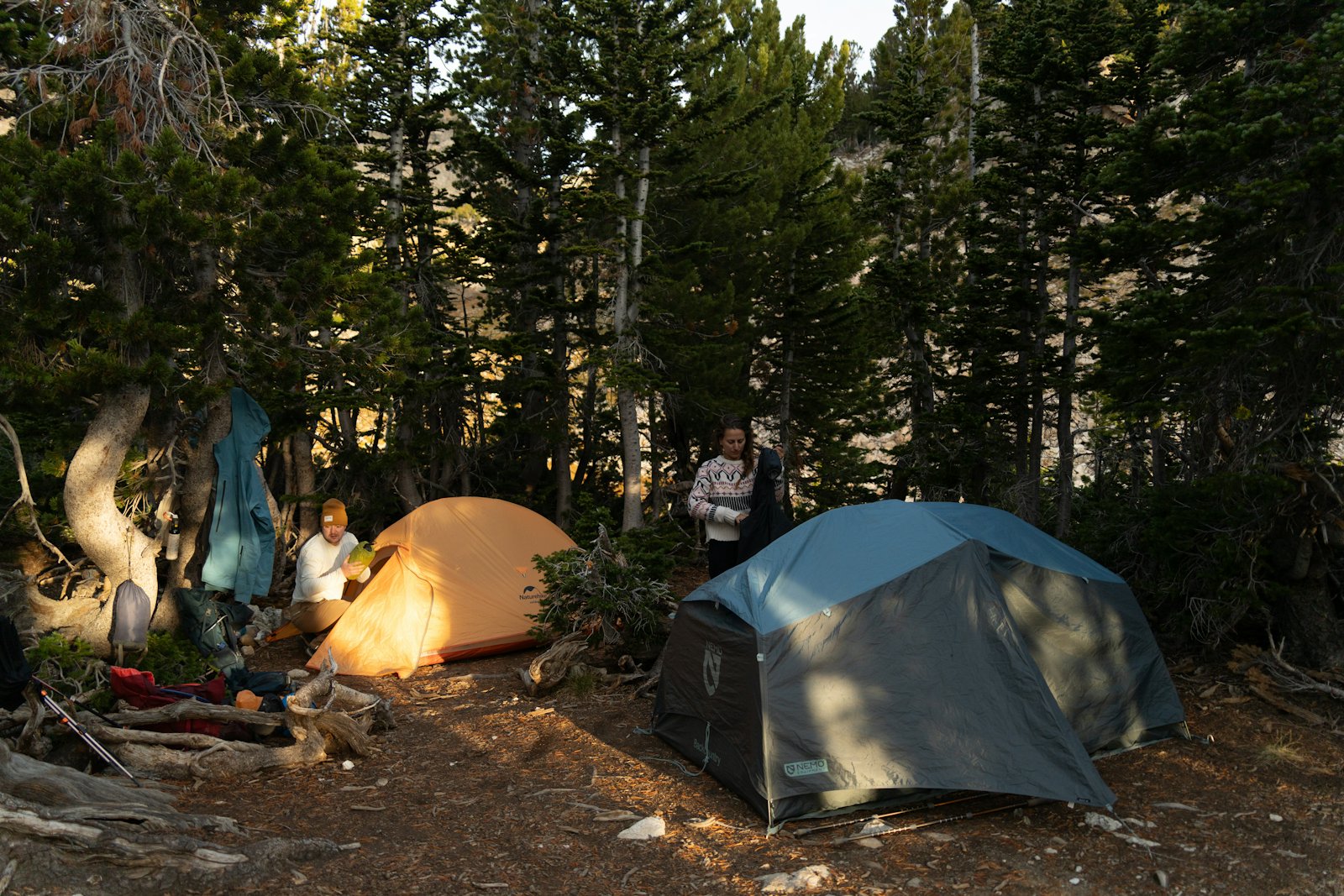
Walk the pitch before you unpack a thing
Five checks, in this order:
1. Is it flat, and which way does it slope?
Nowhere is truly flat. Find the flattest patch, then lie down on it — actually lie down. You will feel a slope your eyes miss entirely. If there is any gradient, sleep with your head uphill. Sleeping head-down is the difference between waking rested and waking with a headache.
2. Where will water go if it rains?
Look for the low point, and do not pitch in it. Avoid obvious channels, depressions, and the base of slopes. Slightly raised ground is worth a lot more than slightly softer ground.
Do not dig a trench around your tent. It is an old habit, it damages the site, and a modern taped-seam floor does not need it.
3. What is above you?
Look up before you pitch. Dead branches — "widowmakers" — come down in wind, and they come down without warning. Avoid anything hanging overhead that you would not want to be under. Also avoid pitching directly beneath a full canopy in cold weather: it blocks the sky, which sounds cosy but means more condensation and dripping in the morning.
4. Which way is the wind, and where does the sun rise?
Pitch with the smallest end or the back of the tent into the prevailing wind, and the door away from it. And note where the sun will come up — a tent in direct morning sun becomes an oven by 7am in summer, which is wonderful in October and miserable in July.
5. How far is the toilet, and is there a light on the way?
This sounds trivial until 2am with a five-year-old. Close enough to walk in the dark, far enough that you do not hear the door all night. Somewhere in the middle of the campground rather than beside the block itself.
Never pitch in a dry streambed, however flat and inviting it looks. Flash floods fill them fast and without any rain falling where you are. If the ground is smooth gravel in a shallow channel, walk away.
Now set up, in this order
Order matters because each step buys you time for the next one.
- Tent first. Before you explore, before you open a drink, before anything is unpacked. Shelter exists, and now everything else is optional.
- Sleep system out immediately. Pads inflated, bags unstuffed and lofting. Compressed insulation takes about an hour to recover its warmth — start that clock early.
- Lights placed while you can still see. A headlamp findable in each tent, the lantern on the table, low lights along the guy lines people will walk near.
- Kitchen set up. Table, stove, water. Four stations: prep, heat, serve, wash.
- Then relax. Chairs out, and that is the trip started.
All of the above assumes you arrived with daylight. Our planner calculates sunset for your date and location, then tells you what time to pull out of the driveway.
Use the leave-by planner →Pegs, guy lines and the wind
Almost every tent failure in wind is a pitching failure rather than an equipment failure.
- Peg at 45 degrees, pointing away from the tent. Straight-down pegs pull out.
- Use all the guy lines, not just the two obvious ones. They are what stop the fly touching the inner — and where fly touches inner, you get wet.
- Keep the fly taut. A slack fly flaps, flapping wakes people, and a flapping fly rubs through.
- Re-tension after dark. Nylon and polyester slacken as they cool and absorb dew. Two minutes before bed is worth it.
- Rocky ground? Tie the guy line around a heavy rock rather than fighting the peg.
Campground etiquette, briefly
Three things cover almost all of it: do not walk through other people's sites — the invisible boundary is real and universally respected; keep white light out of other tents, switch to red once it is properly dark; and observe quiet hours, which are usually 10pm to 7am and are the reason families keep coming back to a campground.
Before you go to bed
- Food and anything scented sealed and out of the tent — in the car, or a locker where one is provided.
- Fire completely out. Not glowing. Out, cold to the back of your hand.
- Anything that can blow away weighted down or packed.
- Fly re-tensioned, vents open even if it is cold. A sealed tent is a wet tent.
The free Clarion Camp Checklist covers what to bring; this covers what to do when you get there. New to all of it? Start with the nine-step walkthrough.
Gear that backs this up
Reading about it is step one.
Every kit we sell is built on the same principle as this guide — fewer, better decisions made before you leave the driveway.
Keep reading
More from the field

first time
Solo Camping for the First Time: Safety and Gear
Solo camping is a different experience than group camping in almost every way — more quiet, more internal, and more demanding. You make every...

environment
Leave No Trace: The Complete Field Guide
Leave No Trace isn't a set of rules about what you can't do. It's a framework for making decisions when the right answer isn't...

forecast
How to Read a Weather Forecast Before You Head Out
The forecast you read at home on Monday looks nothing like what the mountain weather briefing says on Thursday. The further in advance you...

Before your next trip
Get the checklist that ends the 9pm 'did we bring…?'
One email when we publish a new field guide, plus the Clarion Camp Checklist.